Arsenic is a naturally occurring element found in rivers, lakes and groundwater. However, it exists in several chemical forms that differ in their mobility and toxicity. Understanding its environmental impact therefore requires knowing not only how much arsenic is present, but also which forms occur in the water.
Can we trust our arsenic measurements?
One technique used to monitor arsenic is Diffusive Gradients in Thin-Films (DGT).
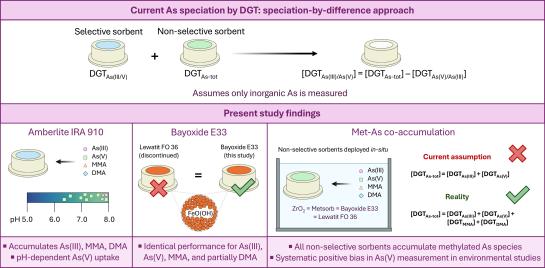
These small passive sampling devices are placed directly in water, where special binding materials gradually capture dissolved arsenic. To distinguish between different arsenic species, researchers often deploy two DGT samplers in parallel: one containing a material designed to capture total readily available arsenic, and another containing a selective material intended to capture only one specific form, such as arsenite (As(III)) or arsenate (As(V)). By subtracting the concentration measured by the selective sampler from the total, the concentration of the other inorganic arsenic species can be estimated. This approach, known as “speciation by difference”, assumes that the selective material captures only its target species and that the total sampler measures the relevant inorganic forms.
But what if these assumptions are not correct?
In our new study, we investigated how reliably different DGT sorbents perform under laboratory conditions and during field deployments in the Scheldt estuary.
What did we discover?
We found that a material previously proposed for selectively measuring arsenate (As(V)) did not consistently capture it under the tested conditions. Its performance depended strongly on water chemistry and sampling duration, making it unsuitable for reliable quantitative As(V) measurements under those conditions.
We also discovered that materials commonly used to measure total readily available arsenic capture methylated arsenic compounds (MMA and DMA), which can occur naturally in aquatic environments. This means that the total DGT measurement may include more than just the two inorganic arsenic species, potentially leading to an overestimation of arsenate when calculated by difference.
Our study also identified Bayoxide E33 as a suitable alternative to a discontinued material used for total arsenic monitoring with DGT.
Why does this matter?
DGT remains a valuable tool for monitoring arsenic in aquatic environments. However, our findings show that using different binding materials to distinguish arsenic species is not always reliable and requires careful validation. Reliable environmental monitoring depends not only on measuring arsenic accurately, but also on understanding exactly what is being measured.
Read the study: Palko Smolíková et al., Reassessing Arsenic Speciation by Diffusive Gradients in Thin-Films: Limits of Selective Sorbents and Hidden Biases from Methylated Species, Analytica Chimica Acta.
https://www.sciencedirect.com/science/article/pii/S0003267026014881?dgcid=author