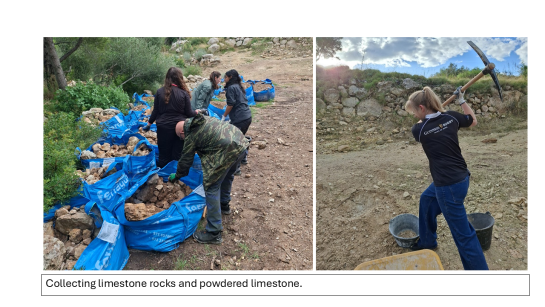
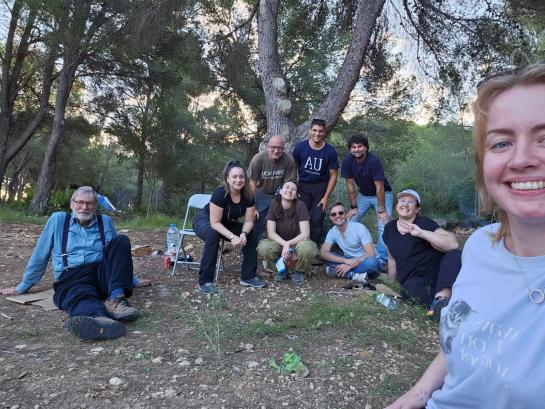
During the first week of November, members of our BB-Lab team, together with Guy de Mulder from UGent and Mark Van Strydonck, travelled to Mallorca to carry out a burning experiment. But this time, with LIMESTONE!
During the Iron Age, the use of limestone in cremation rituals became common in Mallorca and Menorca. Local communities seem to have practised a very unusual form of cremation involving limestone, resulting in what archaeologists call lime burials.
Although this funerary practice has been studied for more than 20 years, we still don't know exactly how these cremations were carried out. Was powdered limestone used to cover the bodies before they were burned? Or were blocks of limestone placed around the pyre? Were the cremated bones washed with water afterwards, or simply left exposed to the elements?
These are just some of the questions behind the different theories we decided to put to the test!
Our colleagues Manu Calvo and David Javaloyas, from the Balearic Islands, welcomed us to Parc Sa Morisca, where we set up our experiment.
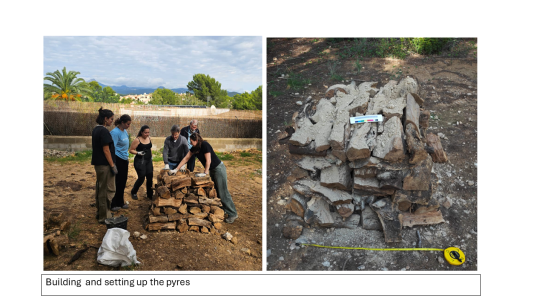
We used pig legs to simulate human remains and built five experimental pyres to try to recreate a Balearic lime burial.
And we weren't alone!
A fantastic team of enthusiastic collaborators joined us. Xavi Argulló, a PhD student from the University of Alicante, collected samples for micromorphological analysis, while Jaume Deyá and three students from the University of the Balearic Islands helped us throughout the experiment.
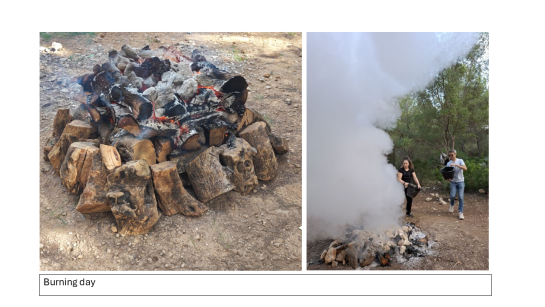
During the burning, we closely monitored the pyres and regularly recorded the temperatures to keep track of the burning conditions. The temperatures reached over 1,000°C, and the fires burned for more than five hours!
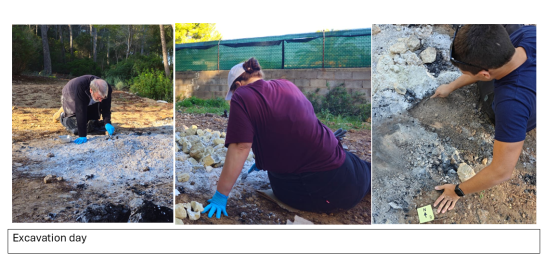
The following day, once the fires had completely cooled, we returned to collect the remaining bones. These were brought back to Brussels, where we will analyse them in our lab using infrared and isotopic techniques. We will then compare the results with archaeological samples to see what they can tell us about how these ancient cremation rituals were done.
This experiment is part of Oriana Chiappa's FWO-funded research project BALEARC, as well as a UGent BOF-funded project.